
Stablecoin Corporate Payments: A 2026 Guide for Businesses
Stablecoin Corporate Payments: A 2026 Guide for Businesses
Stablecoin corporate payments have moved from experimental treasury experiments to a practical operating layer for modern businesses. Between October 2024 and October 2025, stablecoins processed roughly $9 trillion in adjusted payment activity, up 87% year over year, according to Stripe's stablecoin payments research. B2B transfers are a major driver of that growth.
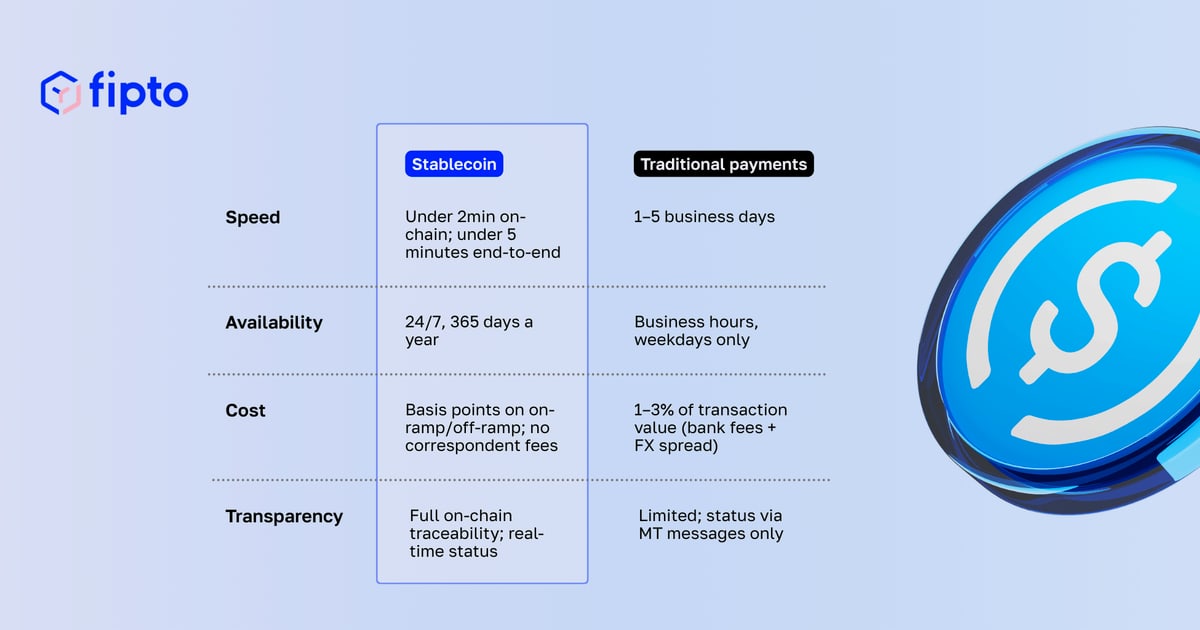
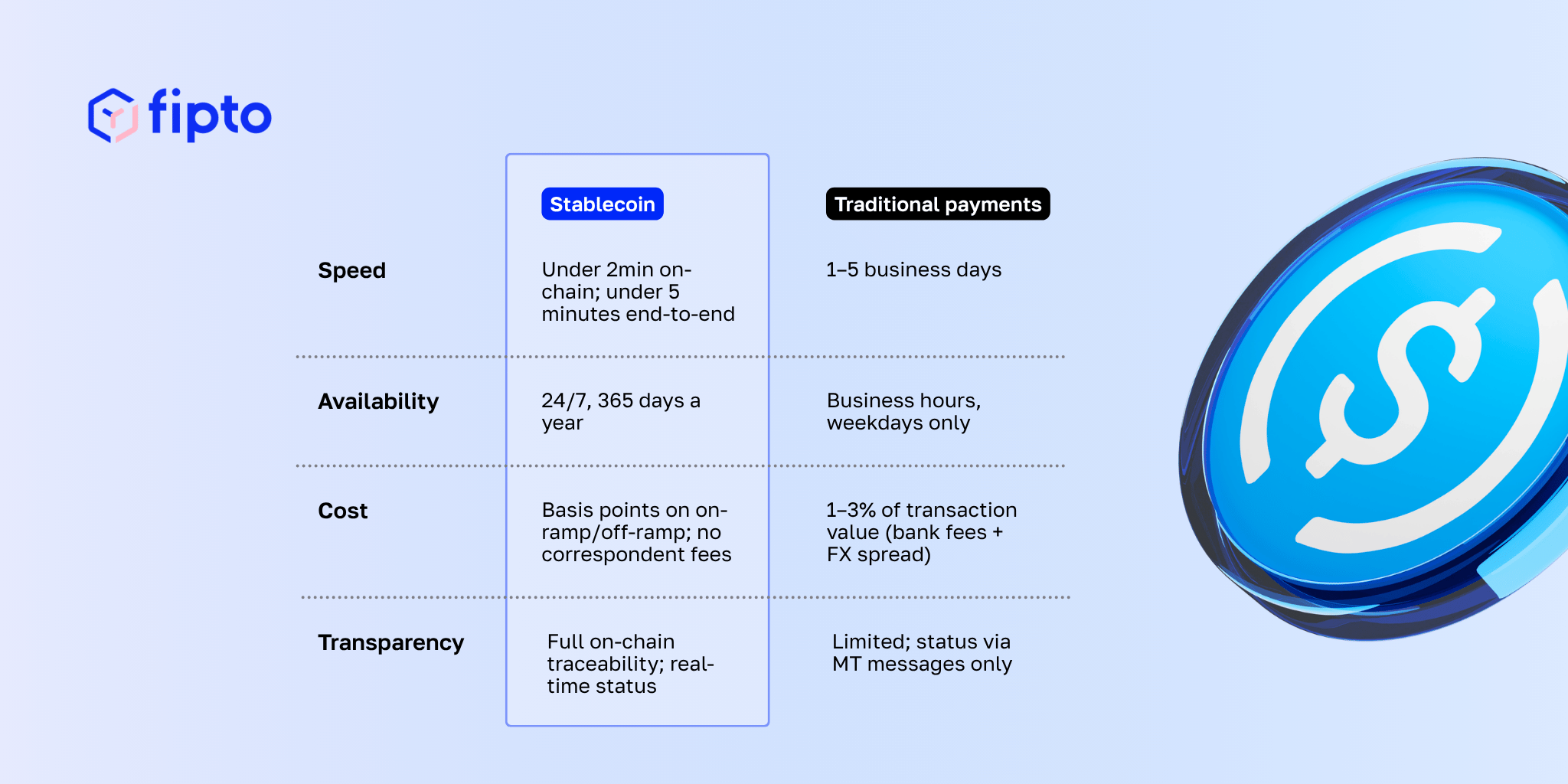
The reason is straightforward: traditional cross-border payment rails still operate on banking hours, correspondent bank chains, and multi-day settlement windows. Stablecoins settle on blockchain networks in seconds to minutes, any day of the year. For finance teams managing global suppliers, contractors, ad spend, and SaaS subscriptions, that difference is material.
This guide explains how stablecoin corporate payments work, where they deliver the most value, the risks to manage, and how corporate virtual cards bridge the gap between stablecoin balances and everyday business spending.
What Are Stablecoin Corporate Payments?
Stablecoin Corporate Payments: A 2026 Guide for Businesses - What Are Stablecoin Corporate Payments?.
A stablecoin corporate payment is a business-to-business or business-to-vendor transfer that uses a digital token pegged to a fiat currency, most commonly the US dollar. Unlike volatile cryptocurrencies, stablecoins such as USDC and USDT are designed to hold a consistent value, making them practical for operational payments where predictability matters.
The two dominant stablecoins for corporate use are USDC, issued by Circle and backed 1:1 by cash and short-duration US Treasuries, and USDT, issued by Tether and backed by a mix of T-bills, cash, and other assets. Together they represent the vast majority of stablecoin market value, according to Reap's business stablecoin payment guide.
Business stablecoin volumes reached approximately $390 billion in 2025 across B2B transfers, payroll, remittances, and capital-markets settlement. The adoption curve is steep because the core value proposition is simple: move dollar-denominated value across borders without the correspondent banking chain.
How Stablecoin Corporate Payments Work

Stablecoin Corporate Payments: A 2026 Guide for Businesses - How Stablecoin Corporate Payments Work.
The settlement flow for a stablecoin corporate payment follows a consistent sequence:
Fiat converts to stablecoins. The sending business converts its local currency into USDC or USDT through a payment provider or exchange. In many cases, crypto-native companies already hold stablecoins as part of their treasury.
The transfer is broadcast to the blockchain. The provider submits the transaction to a network such as Ethereum, Solana, or Tron. No correspondent banks are involved, and no cut-off times apply.
Settlement completes in seconds to minutes. The blockchain network confirms the transfer directly, without the multi-day clearing process typical of SWIFT wires.
The recipient receives stablecoins or local fiat. If the vendor holds a stablecoin wallet, funds arrive immediately. If the vendor expects local currency, the payment provider converts the stablecoins and credits their bank account. This model, where stablecoins handle the settlement leg while both parties interact in fiat, is often called the stablecoin sandwich.
For most corporate deployments, businesses never interact directly with a blockchain. Payment providers abstract the on-chain complexity, handle custody, and manage the fiat conversion on both ends.
Why Businesses Are Adopting Stablecoin Payments
Stablecoin Corporate Payments: A 2026 Guide for Businesses - Why Businesses Are Adopting Stablecoin Payments.
Faster Cross-Border Settlement
A SWIFT wire from Hong Kong to a supplier in Brazil can take two to five business days and pass through multiple correspondent banks. A stablecoin payment on a major blockchain settles in under ten minutes, regardless of banking hours or holidays. For businesses managing time-sensitive payables or multi-geography payroll, that speed translates directly into working capital efficiency.
Visa's B2B stablecoin payments analysis frames the problem well: negotiations now happen digitally in near real time, but traditional bank settlement remains calendar-bound. Stablecoins close that gap.
Lower Transaction Costs
Traditional cross-border payments accumulate fees at every hop: wire transfer charges, interchange fees, cross-border surcharges, foreign exchange spreads, and intermediary bank deductions. Stablecoin transfers typically incur a flat network fee, often pennies. For AI businesses using Stripe, stablecoin payments cost about half as much in transaction fees compared with other payment methods.
24/7 Availability
Blockchain networks do not observe banking hours, weekends, or local holidays. A payment initiated on a Friday evening settles the same way as one on a Tuesday morning. This matters most for businesses operating across time zones, where a banking cut-off in one region can delay a payment by days in another.
On-Chain Transparency
Every stablecoin transaction is recorded on a public blockchain ledger with a timestamp, transaction hash, and exact amount. Finance teams can verify payment status in real time without waiting for bank confirmations or chasing intermediary institutions.
Programmable Payment Logic
Smart contracts allow businesses to embed payment conditions directly into transactions: escrow arrangements, milestone-based releases, and automated disbursements. Traditional rails do not support the same kind of on-rail programmability.
Common Corporate Use Cases
Stablecoin Corporate Payments: A 2026 Guide for Businesses - Common Corporate Use Cases.
Supplier and Vendor Payments
Cross-border supplier payments are the most established stablecoin corporate use case. A business in Singapore paying a manufacturer in Vietnam or a contractor in Brazil can settle in minutes instead of days, with full on-chain visibility and lower total cost.
Contractor Payroll and Global Teams
Companies with distributed teams use stablecoins to pay contractors in markets where traditional banking is slow, expensive, or inaccessible. The recipient can receive stablecoins directly or have the provider convert to local fiat on arrival.
Treasury Management
Businesses that hold stablecoins as part of their treasury can use them directly for operational payments without converting back to fiat first. This reduces FX friction and keeps working capital liquid.
Digital Advertising and SaaS Spend
Crypto-native companies and globally scaling startups increasingly fund their operational spending, including digital ads, AI tool subscriptions, and cloud services, from stablecoin balances. This is where corporate virtual cards enter the picture.
Stablecoin Corporate Cards: Making Stablecoins Spendable Everywhere
Holding stablecoins is one thing. Using them to pay for Meta Ads, AWS, ChatGPT, or a business trip is another. Most vendors do not accept stablecoins directly. Corporate virtual cards solve this by bridging stablecoin balances to the card networks that merchants already accept.
A stablecoin corporate card platform lets a business fund a single account with USDT or USDC, then issue multi-currency virtual cards to teams at scale. Each card draws from the stablecoin balance, converts to the merchant's currency at the point of transaction, and settles automatically. The business never needs to manually off-ramp stablecoins to fiat for routine spending.
This model preserves the advantages of stablecoin treasury management while keeping the transaction experience identical to a standard corporate card. Visa's analysis describes the same pattern: stablecoin-linked commercial cards allow automated agents and finance teams to pay via standard card rails while funding transactions from always-available, programmable stablecoin balances.
Key Benefits of Stablecoin Corporate Cards
- No manual off-ramping. Spend stablecoins directly on everyday business expenses without converting to fiat first.
- Multi-currency settlement. Cards handle automatic currency conversion at the point of transaction, eliminating separate FX steps.
- Granular spend control. Issue cards per team, vendor, or campaign with individual limits and real-time visibility.
- High-limit ad spend. Dedicated virtual cards for ad platforms can reduce account ban risks and simplify budget management across Meta, Google, and TikTok.
- Segregated fund custody. Client funds held in segregated accounts with licensed custodians, never lent or invested.
For a deeper look at how to manage crypto corporate cards across ads, SaaS, AI tools, and travel, see our business crypto card management playbook.
Stablecoin Corporate Payments vs. Traditional Rails
| Factor | SWIFT Wire | Stablecoin Payment | Stablecoin Corporate Card |
|---|---|---|---|
| Settlement time | 2–5 business days | Seconds to minutes | Instant authorization, same-day settlement |
| Availability | Banking hours only | 24/7/365 | 24/7/365 |
| Cost structure | Wire fees + correspondent bank deductions + FX spreads | Flat network fee, often pennies | Card network fees, typically lower than wire total cost |
| Transparency | Limited tracking between banks | Public on-chain record | Real-time transaction visibility in platform |
| Merchant acceptance | Bank account required | Wallet required | Anywhere cards are accepted |
| Chargebacks | Not applicable | Not supported on-chain | Standard card chargeback rules apply |
Each option has a role. Stablecoin payments excel at the cross-border middle mile. Stablecoin corporate cards extend that utility to everyday merchant spending. Traditional wires remain relevant for large, one-off transfers where both parties prefer bank rails.
Risks and Considerations
Regulatory Clarity
Stablecoin regulation is evolving. In the US, the GENIUS Act will reshape reserve requirements and issuer oversight when it takes effect by 2027. Businesses should work with providers that operate through licensed partners in the jurisdictions where they transact.
Compliance Requirements
Stablecoin payments still require sanctions screening, transaction monitoring, and KYC checks where thresholds or regulations apply. Blockchain analytics tools integrated into payment platforms handle much of this automatically, but businesses should understand their provider's compliance posture.
Network Fragmentation
USDC and USDT run on multiple blockchains. A business holding USDC on Ethereum cannot send it directly to a wallet on Solana without a bridge. Payment providers abstract this complexity, but businesses managing stablecoins directly must clarify which networks they support.
Regional Off-Ramp Differences
Stablecoins excel at the cross-border middle mile, but the last mile into local currency varies by market. Some regions have strong liquidity and bank integrations; others add costs or delays. This is another reason corporate card platforms, which handle conversion at the point of transaction, can be more practical than direct stablecoin transfers for routine spending.
How to Implement Stablecoin Corporate Payments
1. Identify the Real Use Case
Start with the specific payment pain point: slow supplier settlement, expensive cross-border payroll, manual FX conversions, or the need to spend stablecoin treasury balances directly. Stablecoins deliver the most value where traditional rails are slowest or costliest.
2. Choose the Right Infrastructure
For supplier payments and payroll, a payment provider that handles fiat-to-stablecoin conversion, on-chain settlement, and recipient fiat off-ramp is sufficient. For operational spending such as ads, SaaS, and travel, a stablecoin corporate card platform is the more practical route because it extends stablecoin utility to any merchant that accepts cards.
3. Establish Treasury and Custody Controls
If the business holds stablecoins directly, secure custody is non-negotiable. Look for providers that hold client funds in segregated accounts with third-party licensed custodians and follow security practices guided by recognized standards such as ISO/IEC 27001.
4. Integrate with Existing Finance Workflows
The best stablecoin payment infrastructure fits into existing accounting and reconciliation processes. Real-time transaction visibility, automatic multi-currency settlement, and exportable records reduce the operational burden on finance teams.
5. Start with a Pilot
Begin with a single corridor or spend category, measure settlement time and total cost against the previous rail, then expand. Most businesses find that stablecoin corporate cards are the easiest entry point because they require no changes to vendor acceptance or internal payment processes.
Related reading
- How to Avoid Foreign Card Declines: 15 Causes and Fixes - Learn why foreign card declines happen and how to prevent them. Covers bank fraud flags, DCC, 3DS failures, limits, and stablecoin virtual card fallbacks.
- USD/CNY Exchange Rate: How the Dollar-Yuan Pair Works - Understand the USD/CNY exchange rate, what drives the dollar-yuan pair, how to read live quotes, and what it means for businesses and cross-border payments.
Frequently Asked Questions
What is a stablecoin corporate payment?
A stablecoin corporate payment is a business transfer using a digital token pegged to a fiat currency, typically USDC or USDT. The value moves across a blockchain network and settles in seconds to minutes, rather than days on traditional banking rails.
Are stablecoin payments cheaper than wire transfers?
In most cross-border scenarios, yes. Stablecoin transfers incur a flat network fee, often pennies, while SWIFT wires accumulate correspondent bank deductions, FX spreads, and intermediary charges at each hop. The total cost difference compounds for high-volume senders.
Can a business pay suppliers with stablecoins if the supplier does not accept crypto?
Yes. Payment providers can convert stablecoins to local fiat on the recipient's end, so the supplier receives funds in their expected currency. Alternatively, a stablecoin corporate card lets the business pay any merchant that accepts cards, with conversion handled automatically.
What is the difference between USDC and USDT for corporate payments?
Both are USD-pegged stablecoins, but they differ in issuer, reserve composition, and attestation practices. USDC is backed 1:1 by cash and short-duration US Treasuries with monthly attestations. USDT is backed by a mix of T-bills, cash, and other assets with quarterly reserve reviews. Businesses should evaluate both against their own risk tolerance and regulatory requirements.
Do stablecoin payments support chargebacks?
No. Once a stablecoin transaction is confirmed on-chain, it cannot be reversed by a bank or network. Refunds require a new on-chain transaction. Stablecoin corporate cards, however, operate on card rails and retain standard chargeback rules.
How do stablecoin corporate cards work?
A business funds an account with USDT or USDC, then issues virtual cards to teams or departments. Each card draws from the stablecoin balance, converts to the merchant's currency at the point of transaction, and settles automatically. This makes stablecoins spendable anywhere cards are accepted.
What are the main risks of stablecoin corporate payments?
The primary risks are regulatory uncertainty, compliance obligations, network fragmentation, and regional off-ramp friction. Working with providers that use licensed partners, segregated custody, and integrated compliance tooling mitigates most of these concerns.
Conclusion
Stablecoin corporate payments have crossed the threshold from niche experiment to practical treasury tool. The combination of faster settlement, lower costs, 24/7 availability, and on-chain transparency addresses real pain points in cross-border B2B payments that traditional rails have not solved.
The most practical entry point for many businesses is a stablecoin corporate card platform. It preserves the benefits of holding and transacting in stablecoins while extending that utility to the merchants, platforms, and services that teams already use every day. For companies that hold USDT or USDC and want to put those balances to work on ads, SaaS, AI tools, or travel, the infrastructure now exists to do so without manual off-ramping or vendor-side changes.
To explore how stablecoin corporate cards fit into a broader payment strategy, see our guide on simplifying business crypto payments in 2026 or read the Cardfornia review for a detailed look at USDT and USDC corporate virtual cards.