
Reap Review 2026: Stablecoin Payments & Card Issuing
Reap Review 2026: Stablecoin-Powered Global Payments and Card Issuing
Reap is a Hong Kong-based payments technology company that connects traditional finance with stablecoin rails. It offers cross-border payment processing and card issuing infrastructure, with a strong focus on Web3 businesses and emerging markets. This review examines what Reap actually does, who benefits most, where it falls short, and what to weigh before adopting it.
What Reap Is and How It Works
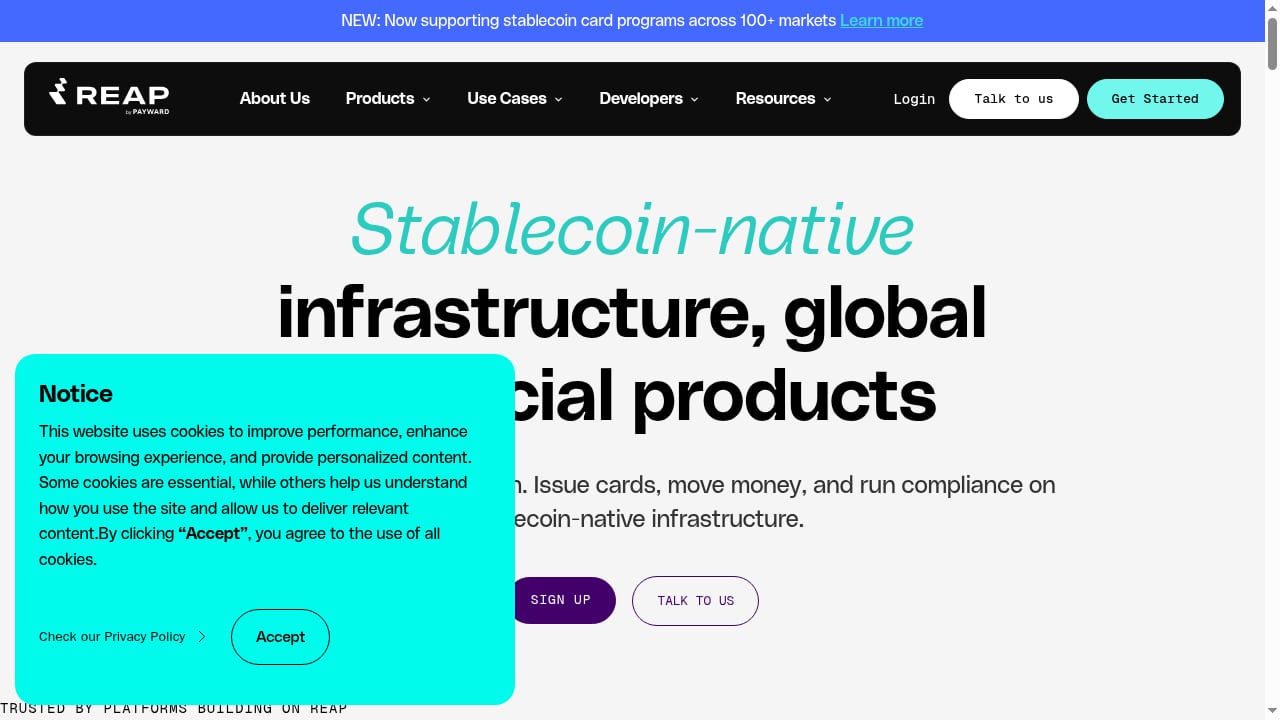
First viewport screenshot of reap.global.
Reap started in 2018 as a traditional payment provider and later expanded into serving Web3 customers. Today, the majority of its customer base is Web3-oriented, spanning payment intermediaries, crypto exchanges, and businesses that need to move money across borders efficiently.
The platform combines two core capabilities:
- Stablecoin-powered cross-border payments. Businesses can send and receive international payments using stablecoins, bypassing some of the delays and costs associated with correspondent banking.
- Card issuing infrastructure. Reap provides the rails for issuing payment cards, including virtual cards, that can be funded and managed through its platform. This is particularly relevant for teams that hold stablecoin balances and want to convert them into spendable fiat at the point of sale.
Reap's blockchain operations rely on infrastructure from Fireblocks, including a policy engine for transaction authorization, a gas station for multi-chain operations, and API access for building purpose-driven wallets. According to Fireblocks' customer case study, Reap processes hundreds of millions of dollars in crypto monthly and has expanded across Tron, Polygon, and Solana.
Who Reap Is Built For
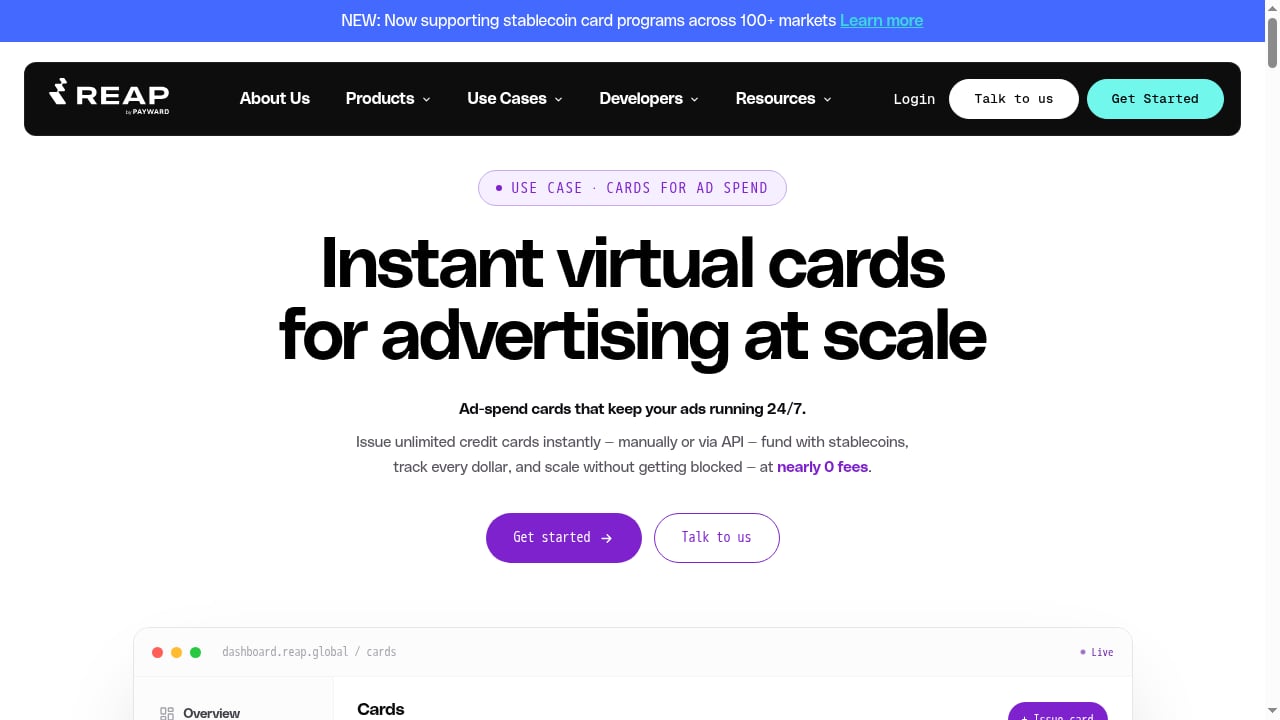
First viewport screenshot of reap.global.
Reap is not a general-purpose neobank. Its ideal users share specific characteristics:
Web3-native businesses
Crypto exchanges, payment intermediaries, remittance providers, and DAO-adjacent entities that already hold stablecoin treasuries and need to deploy them for operational spending or cross-border settlement.
Businesses operating in or with emerging markets
Reap has identified particular demand in Latin America, where cross-border stablecoin flows are already substantial. Companies trading with or within regions where traditional banking connectivity is slow or expensive may find stablecoin rails more practical.
Platforms that need card issuing as a service
If you are building a product that requires white-label or integrated card issuing, Reap's infrastructure approach may fit better than a consumer-facing card app.
Teams with finance operations that need controls
Reap's use of Fireblocks' policy engine suggests that workflow authorizations and volume thresholds are part of the operational model. Finance teams that need approval layers and audit trails should evaluate this closely.
Key Use Cases
Cross-border supplier payments. A business in Asia paying a supplier in Latin America can settle in stablecoins rather than waiting days for a wire transfer. Reap's infrastructure is designed for this flow.
Card spending from stablecoin balances. Teams that hold USDT or USDC can issue cards and manage spending without manually converting to fiat through a separate exchange.
Remittance and payment intermediary operations. Companies building remittance products can use Reap's rails to move funds more efficiently than traditional correspondent banking allows.
Treasury operations for crypto-native firms. Businesses that want to keep funds in stablecoins but need to pay for real-world expenses, subscriptions, or travel can use Reap's card infrastructure to bridge the gap.
Strengths
- Stablecoin-first design. Reap was built for businesses that already operate with digital assets, not as an afterthought to a fiat product.
- Multi-chain support. Through Fireblocks, Reap supports Tron, Polygon, and Solana, among other networks. This matters for businesses whose counterparties use different chains.
- Security infrastructure. The Fireblocks policy engine provides transaction authorization controls, volume caps, and workflow approvals that mirror traditional finance controls.
- Emerging-market focus. Reap has deliberately targeted regions where traditional payment rails are inefficient, which aligns with where stablecoin adoption is growing fastest.
- Scaled operations. Processing hundreds of millions monthly suggests the platform has moved beyond proof-of-concept and can handle meaningful volume.
Limitations and Considerations
- Limited public pricing. Reap does not publish detailed fee schedules. Pricing likely depends on volume, payment corridors, and card program structure. Buyers should expect a sales-led process and request corridor-specific quotes.
- Regulatory complexity. Stablecoin payments sit at the intersection of multiple regulatory regimes. Businesses operating in or with jurisdictions that restrict stablecoin use should verify Reap's coverage before committing.
- Web3 orientation may not suit traditional businesses. If your finance team is not comfortable with stablecoin treasury management, the operational learning curve is real.
- Corporate ownership transition. In May 2026, Bloomberg reported that Payward Inc., the parent of Kraken, agreed to acquire Reap for $600 million. While this may bring resources and integration benefits, it also introduces uncertainty about product direction and prioritization during the transition. The Yahoo Finance report notes the deal includes cash and stock.
- Customer reviews are thin. Public review coverage on platforms like Trustpilot is limited, so firsthand user feedback is harder to aggregate than with consumer-facing fintechs.
Pricing Signals
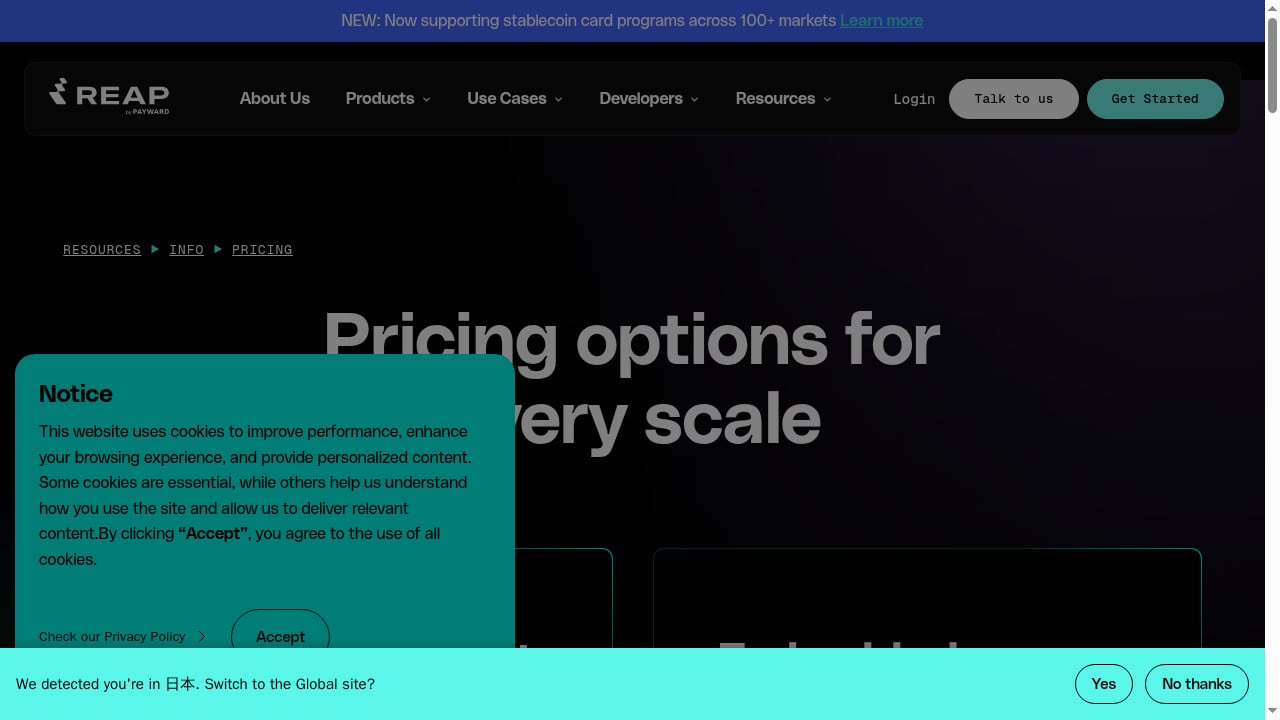
First viewport screenshot of reap.global.
Reap does not publish a standard pricing page with per-transaction fees. Based on the product structure, expect pricing to include:
- Payment processing fees that vary by corridor, currency pair, and volume.
- Card issuing and program fees for businesses building on Reap's infrastructure.
- FX or conversion spreads when moving between stablecoins and fiat currencies.
For comparison, other stablecoin business accounts in the market publish entry pricing. Request Finance's business account, for example, starts around $50 per month. Reap's enterprise-oriented model likely means custom quotes, which can be better for high-volume users but harder for small teams to budget.
Setup and Onboarding
Reap's onboarding is likely to involve:
- Business verification (KYB). Expect document collection, ownership disclosure, and review of your business model, especially if you are a crypto-native entity.
- Use-case review. Reap will want to understand your payment flows, counterparties, and expected volumes.
- Technical integration. If you are using card issuing or payment APIs, engineering work will be required. Fireblocks' API documentation is cited as a factor in Reap's own implementation speed, which suggests a developer-friendly but integration-heavy process.
- Compliance and limits. Initial transaction limits may apply until volume history is established.
Small teams should budget weeks, not days, for full onboarding.
Reap vs. Alternatives
| Criterion | Reap | Typical stablecoin business account | Typical crypto card |
|---|---|---|---|
| Primary focus | Payments infrastructure + card issuing | Stablecoin treasury and payments | Consumer or corporate spending |
| Ideal user | Web3 platforms, exchanges, payment intermediaries | Businesses invoicing in stablecoins | Teams wanting to spend crypto |
| Pricing transparency | Low (custom quotes) | Medium (published tiers) | High (published fees) |
| Multi-chain support | Yes, via Fireblocks | Varies | Usually limited |
| Setup complexity | Higher (KYB + integration) | Moderate | Low |
If you are comparing corporate crypto cards more broadly, our Cardfornia vs Reap vs Banxe comparison breaks down stablecoin funding, virtual card issuance, and team controls side by side. For businesses that need expense management alongside cards, Sparados offers a more traditional corporate card and expense tracking model.
Decision Criteria: Should You Use Reap?
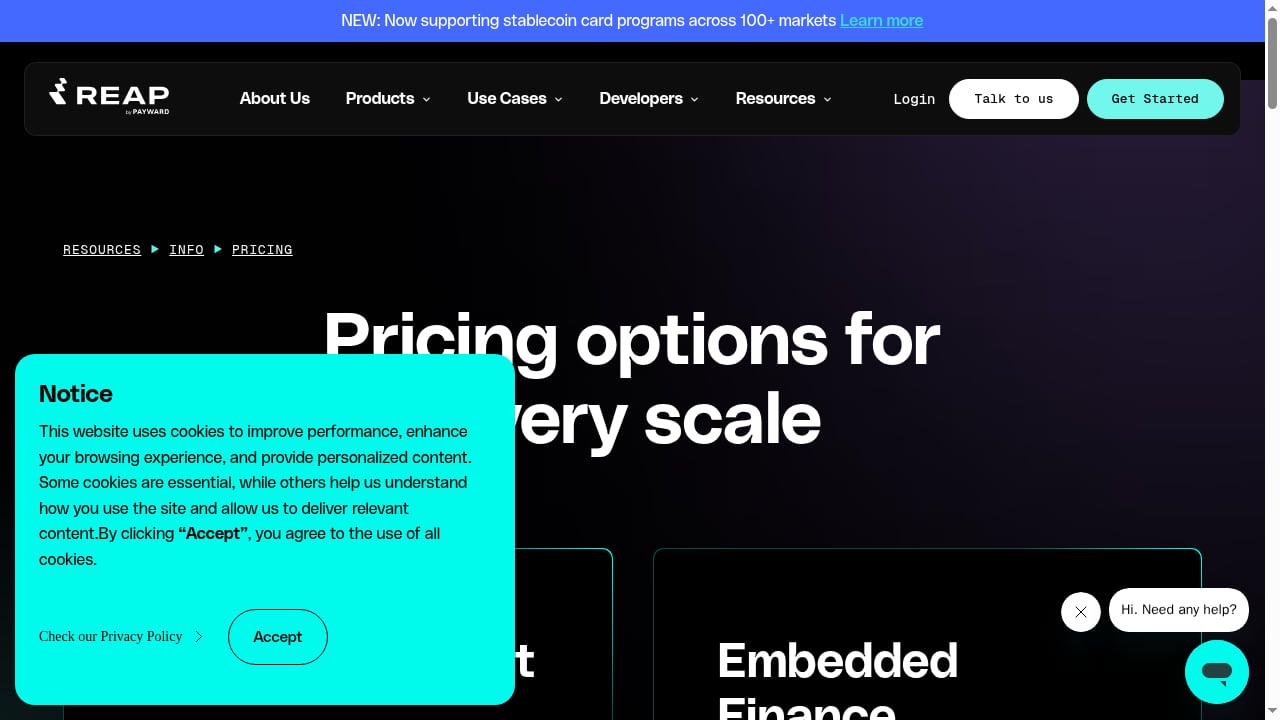
First viewport screenshot of reap.global.
Reap is a strong fit if:
- Your business already holds stablecoin balances and needs to move them across borders or convert them into card spending.
- You operate in or with emerging markets where traditional banking is slow or costly.
- You need card issuing infrastructure rather than a consumer card product.
- Your finance team requires approval workflows and transaction controls.
Reap is probably not the right choice if:
- You need published, predictable pricing for small volumes.
- Your business has no stablecoin exposure and no plans to adopt it.
- You need a simple expense management tool rather than payment infrastructure.
- You are uncomfortable with the uncertainty of a corporate ownership transition.
Related reading
- Wirex Review 2026: Crypto Wallet, Cards & Payments Tested - Evidence-based Wirex review for 2026: card tiers, real cashback math, fees, limits, setup, regional availability, and who should use it.
- Cryptopay Business Review 2026: Crypto Payments for Merchants - Evidence-based Cryptopay Business review: crypto payment gateway features, fiat settlement, payouts, fees, setup, limitations, and who it fits in 2026.
FAQ
Is Reap a bank?
No. Reap is a payments technology provider, not a licensed bank. It provides infrastructure for cross-border payments and card issuing, often in partnership with licensed financial institutions.
Does Reap support multiple blockchains?
Yes. Through its Fireblocks infrastructure, Reap has expanded to support Tron, Polygon, and Solana, among other networks.
Who owns Reap now?
As of May 2026, Payward Inc., the parent company of Kraken, agreed to acquire Reap Technologies for $600 million, according to Bloomberg reporting. The deal was announced but details of full integration were not public at the time of writing.
Is Reap suitable for small businesses?
It can be, but the enterprise-oriented, sales-led model and lack of published pricing may make it less accessible for very small teams. Businesses with modest stablecoin volumes may find simpler alternatives more practical.
What is Reap best at?
Reap's core strength is combining stablecoin payment rails with card issuing infrastructure for Web3-native businesses, particularly in cross-border flows involving emerging markets.
Conclusion
Reap occupies a specific and valuable niche: stablecoin-powered payment infrastructure for businesses that already operate in digital assets. Its multi-chain support, security controls, and focus on emerging-market corridors make it a credible option for Web3 platforms, exchanges, and payment intermediaries. The main trade-offs are pricing opacity, onboarding complexity, and the uncertainty that comes with a major acquisition. Businesses evaluating Reap should request corridor-specific quotes, confirm regulatory coverage for their jurisdictions, and compare against both stablecoin-native alternatives and traditional corporate card providers before committing.