
Request Finance Review 2026: Stablecoin Business Account
Request Finance Review 2026: Business Account for Currencies & Stablecoins
Most crypto-native companies eventually hit the same wall: they hold stablecoins, but their finance operations still run on spreadsheets, manual wallet transfers, and bank accounts that don't speak the same language. Request Finance is one of the platforms trying to close that gap with a single business account for 25+ fiat currencies and stablecoins. This review breaks down what it actually does, who it fits, what it costs, and where it falls short — based on the platform's own product disclosures and independent context on the stablecoin market.
What Request Finance Is (and Isn't)
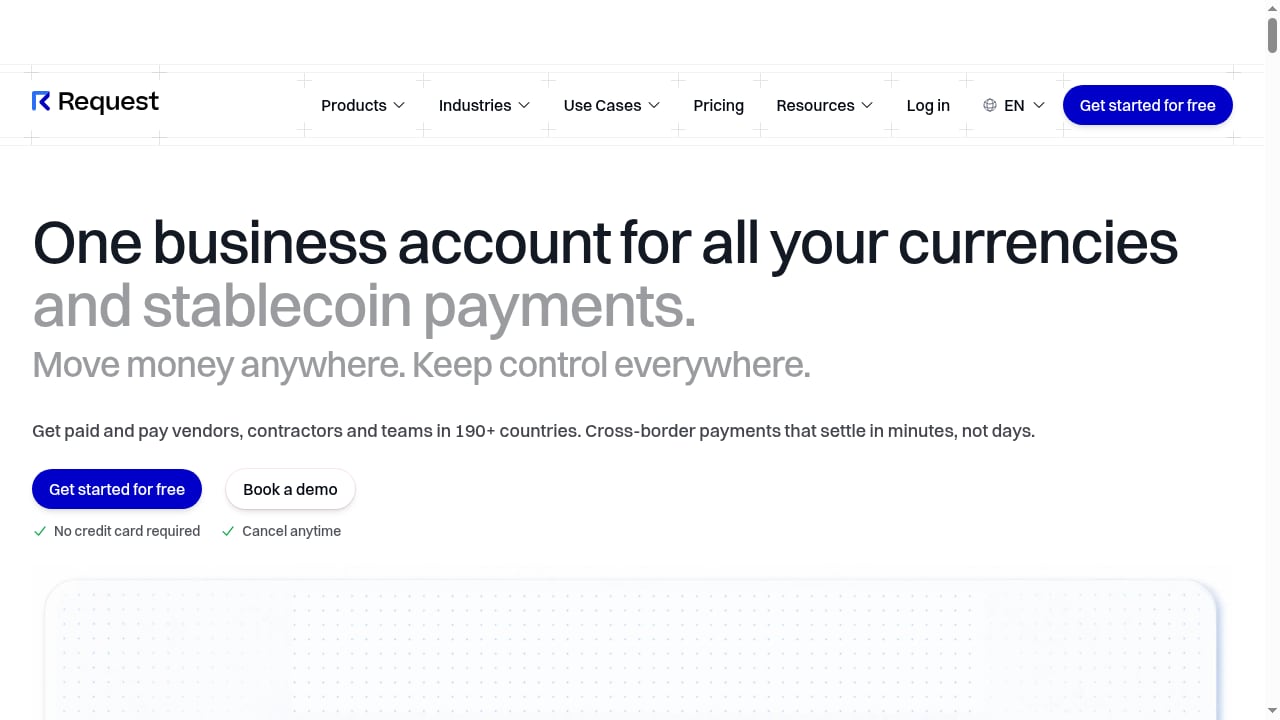
First viewport screenshot of www.requestfinance.com.
Request Finance is a B2B finance platform built around stablecoin payments and cross-border transfers. Its core product is a business account that lets you hold, receive, and send fiat currencies and stablecoins (primarily USDC and USDT) from one place, with virtual IBANs, SWIFT rails, and on-chain wallets under a single dashboard. On top of that account sit invoicing, approval workflows, batch payouts, and accounting records.
It is not a bank, a crypto exchange, or a self-custody wallet. It's a payment operations layer. That distinction matters: if you want to trade tokens or hold your own keys, this isn't the tool. If you want to pay 80 contractors in 30 countries and keep an auditable paper trail, it is designed for exactly that.
The platform reports 1,500+ finance teams and over $1B processed across 190+ countries, with named users including Web3 organizations. Treat those figures as vendor-reported, but they indicate the product is past the experimental stage.
Core Features

First viewport screenshot of www.requestfinance.com.
Multi-Currency and Stablecoin Accounts
One account holds 25+ currencies alongside USDC and USDT wallets, with virtual IBANs and SWIFT access for fiat rails. A real-time cash position view shows balances across currencies, which is the feature most finance teams actually feel day to day.
Invoicing and Accounts Payable
You can create invoices, set approval policies, and pay vendors in local currency or stablecoin. Payments can also be sent directly without an invoice, which suits contractor and ad-hoc vendor flows. Every counterparty is verified, and the platform builds a paper trail for auditors.
Batch Payouts
Upload a recipient list, review it, and pay everyone at once. Stablecoin payouts land in minutes and are free on every plan; bank payouts reach 190+ countries. For affiliate programs, creator payouts, or global payroll, this is the headline feature.
Security and Controls
Request Finance cites SOC 2 Type 1 audit status, insurance through OpenCover, on-chain double-payment detection, and scam vigilance measures. Approval policies and role-based controls are part of the account structure, not an add-on.
Cards (Coming Soon)
Virtual cards funded directly from the account, with budgets and real-time controls, are listed as launching soon. Until then, teams that need corporate crypto cards should look at dedicated providers — our Cardfornia vs Reap vs Banxe comparison covers that category.
Pricing Signals
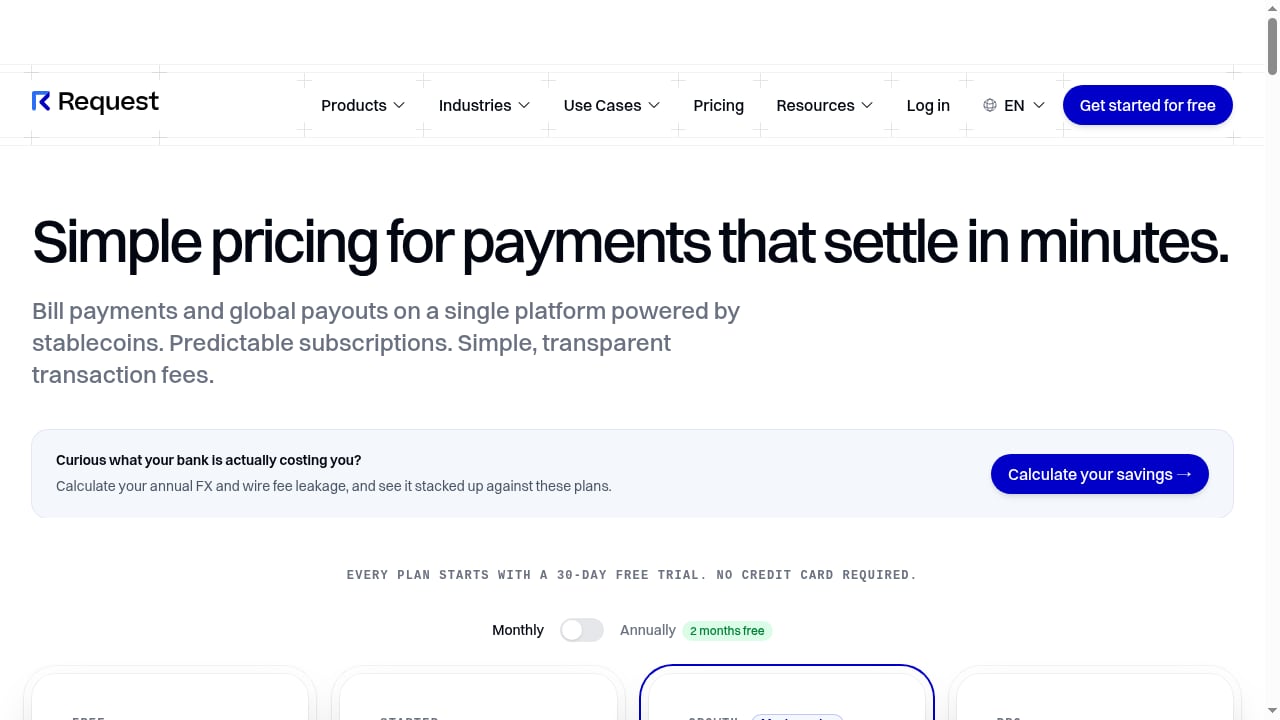
First viewport screenshot of www.requestfinance.com.
Request Finance publishes transparent pricing starting at $50 per month, with no setup fees and stablecoin payouts free on every plan. A 30-day free trial requires no credit card, and invoicing can be used before KYB verification.
What the public pricing page doesn't fully resolve:
- Tier boundaries. The $50 entry point likely covers a limited seat or volume count; larger teams should confirm volume caps and per-transaction fees on bank rails.
- FX costs. The platform claims competitive FX rates versus the 2–8% banks charge on cross-border payments, but actual spreads vary by currency pair.
- Bank payout fees. Stablecoin payouts are free, but fiat payouts to 190+ countries may carry per-transfer costs depending on corridor.
For a business sending $100k monthly in stablecoins, the flat subscription is trivially cheap. For a company mostly on fiat rails, the math needs a corridor-by-corridor check.
Setup and Onboarding
- Create an account. A few minutes, no credit card, 30-day free exploration.
- Verify your business. KYB runs when you activate the business account, typically a few days. Counterparties are verified too.
- Start paying and getting paid. Bank and stablecoin rails, approvals, records, and accounting in one place.
One vendor case study describes onboarding a Delaware C-corp in 11 days over a holiday period, including KYB and AML checks. That's a realistic benchmark: not instant, but faster than most traditional business banking.
A practical note: you can start with fiat global accounts and AP/AR alone and switch on stablecoin payouts later. Teams that aren't crypto-ready can adopt incrementally.
Who It's Best For
- Web3 and crypto-native companies paying contributors, validators, or grantees in stablecoins.
- Global payroll and contractor operations where bank transfers are slow or expensive.
- Accounts payable teams that need approval workflows and audit trails across mixed fiat/stablecoin payments.
- Affiliate and creator payout programs requiring batch disbursement to hundreds of recipients.
- Import/export and marketplace businesses moving money across borders regularly.
Limitations and Trade-offs
- Stablecoin exposure is not risk-free. As J.P. Morgan research notes, stablecoins have de-pegged in the past and are not guaranteed to redeem at par the way bank deposits are. Holding operating cash in USDT or USDC carries issuer and reserve risk that a treasury policy should address.
- Regulatory flux. The GENIUS Act gave the U.S. a framework for stablecoin issuance, but treatment on bank balance sheets, KYC/AML expectations, and redemption mechanics are still evolving. Finance teams should confirm their auditor's stance.
- No self-custody. Funds sit with the platform. That's normal for a finance operations tool, but it's a different risk profile from a hardware wallet.
- Cards are not live yet. If card spend is central to your workflow, this isn't the complete stack today.
- KYB is mandatory for full use. Invoicing works pre-verification, but payments require business verification, which adds days to onboarding.
Request Finance vs. the Alternatives

First viewport screenshot of www.requestfinance.com.
| Need | Request Finance | Stripe Treasury | Crypto card platforms (e.g., Cardfornia, Reap, Banxe) |
|---|---|---|---|
| Stablecoin AP/AR with invoicing | Strong | Limited | Weak |
| Batch stablecoin payouts | Strong | Moderate | Limited |
| Fiat multi-currency accounts | Yes (25+) | Yes (USD, GBP, EUR, etc.) | Varies |
| Corporate cards | Coming soon | Yes (2% cashback) | Core strength |
| Self-custody | No | No | Some offer it |
| Entry pricing | From $50/mo | No monthly fee | Varies |
Stripe Treasury is the closest fiat-first comparator: it bundles multicurrency balances, cards, and stablecoin payouts, but it's built for businesses already inside the Stripe payments ecosystem and its invoicing/AP depth is thinner. If your revenue runs through Stripe, it's worth a serious look. If your payables are stablecoin-heavy and global, Request Finance is more purpose-built.
For teams whose main need is spending stablecoins on subscriptions and vendor cards, a dedicated crypto card is the better fit — see our guide to a crypto card for AI subscriptions for that use case.
Decision Criteria: Should You Use It?
Ask these five questions:
- Do you already hold or receive stablecoins? If yes, Request Finance removes real friction. If no, start with fiat-only and evaluate later.
- How much of your payables are cross-border? Above roughly 20–30% international, the FX and speed savings usually justify the subscription.
- Do you need batch payouts? Paying 20+ recipients monthly is where the platform earns its fee.
- Does your auditor accept stablecoin treasury? Confirm before moving operating cash on-chain.
- Do you need cards now? If yes, pair Request Finance with a card provider or wait for the card launch.
Related reading
- Wirex Review 2026: Crypto Wallet, Cards & Payments Tested - Evidence-based Wirex review for 2026: card tiers, real cashback math, fees, limits, setup, regional availability, and who should use it.
- Banxe Review 2026: Global Payments & Crypto Platform - Evidence-based Banxe review for 2026: fiat-crypto accounts, fees, business features, onboarding, limitations, and who it fits.
- OneSafe Neo-Banking Review: Global Business Fit & Fees - Evidence-based OneSafe review for global businesses: who it fits, real fee signals, onboarding, DAO and Web3 controls, limitations, and decision criteria.
FAQ
Is Request Finance a bank?
No. It's a payment operations platform that provides business accounts with virtual IBANs, SWIFT access, and stablecoin wallets through partner infrastructure. Deposits are not FDIC-insured the way U.S. bank balances are.
How much does Request Finance cost?
Plans start at $50 per month with no setup fees. Stablecoin payouts are free on every plan. A 30-day free trial is available without a credit card. Confirm tier limits and bank payout fees for your corridors before committing.
Does Request Finance require KYB?
Yes, for activating the business account and sending payments. Verification usually takes a few days. You can use invoicing features before completing KYB.
Which stablecoins does it support?
USDC and USDT wallets are the core stablecoin rails, alongside 25+ fiat currencies.
Can I use Request Finance without touching crypto?
Yes. You can run fiat global accounts and AP/AR only, then enable stablecoin payouts when ready.
How does it compare to Coinbase or Binance?
Those are exchanges and wallets, not finance platforms. They lack invoicing, approval workflows, payroll, accounting reconciliation, and bank payouts. Request Finance sits on top as the operations layer.
Conclusion
Request Finance is a credible, purpose-built answer to a real problem: stablecoin-holding businesses need finance operations, not just wallets. Its strengths are batch payouts, multi-currency accounts, approval workflows, and free stablecoin transfers at a predictable subscription price. Its limitations are equally clear — no self-custody, cards still pending, mandatory KYB, and the inherent risks of stablecoin treasury that any CFO should model.
If your business already lives partly on-chain and pays people across borders, it's worth the 30-day trial. If you're fiat-only or card-centric, start with a comparator like Stripe Treasury or a dedicated crypto card platform, and revisit when your stablecoin volume justifies the switch. For a broader view of business crypto payment gateways, our Cryptopay Business review covers the merchant-side alternative.
Sources: Request Finance, Stripe Treasury, J.P. Morgan Global Research on stablecoins