
Banqa Review: Self-Custody USDC Visa Card Tested
Banqa Review: A Self-Custody USDC Visa Card for Everyday Spending
Banqa is a crypto payment card that lets you spend USDC you hold in a self-custody wallet wherever Visa is accepted. It is not a bank account, and it does not custody your funds. If you already hold stablecoins and want a card that spends them without a manual conversion step, Banqa is worth a close look. If you want a traditional bank card with cashback and predictable ATM access, it probably is not.
This review breaks down how Banqa works, what it costs, who it suits, and where it falls short, based on published fee schedules, app store disclosures, and independent card reviews.
What Banqa actually is
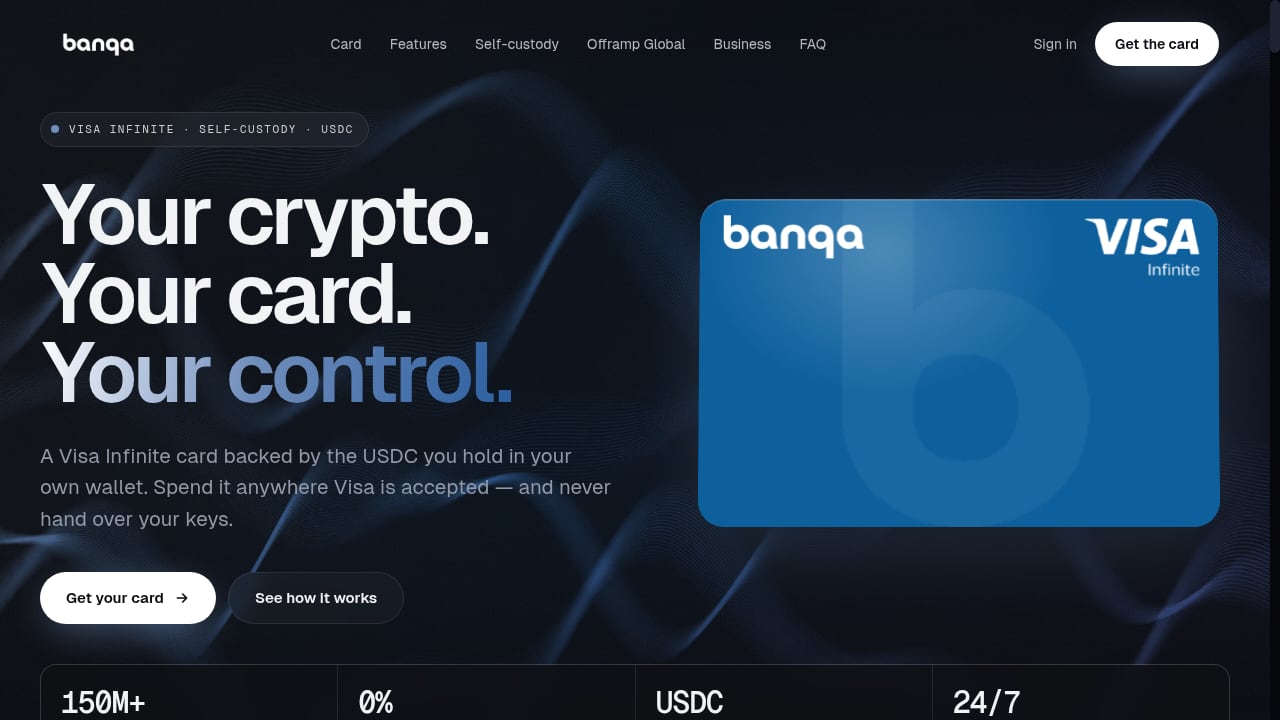
First viewport screenshot of banqa.io.
Banqa is a technology platform that issues a Visa Infinite card backed by USDC you hold as collateral in a smart-contract wallet. The card is issued by a Visa Principal Member under a Visa licence. Banqa itself is not a bank and does not provide deposit insurance or banking services.
The core mechanic: you deposit USDC on Base or Arbitrum into a self-custody wallet, and that collateral supports your card spending. When you pay, the transaction settles over the Visa network in USD. There is no manual conversion step, no lock-up, and Banqa never holds your keys or recovery phrase.
A virtual card is available after identity verification, and a physical card can be ordered. Apple Pay and Google Pay are supported, and the card works at ATMs as well as online and in-store.
Who Banqa is for
First viewport screenshot of banqa.io.
Banqa fits a specific profile. It is not a mass-market debit card.
Good fit:
- People who already hold USDC and are comfortable managing their own keys.
- Users in regions where traditional bank cards are hard to obtain due to residency, documentation, or name-matching issues.
- Freelancers and remote workers who receive stablecoin payments and want to spend them directly.
- Small teams that want a shared USDC treasury with per-employee card limits.
Poor fit:
- Anyone who wants a bank account with deposit protection.
- Users who rely on cash withdrawals as a primary spending method.
- People who want cashback or rewards on everyday spending.
- Users who are not comfortable with self-custody and recovery phrase management.
How setup works
- Create a wallet. Banqa provides a self-custody wallet in its app. Your recovery phrase stays on your device, encrypted.
- Complete KYC. Identity verification is required before a card is issued. A government ID and proof of address are typically needed. Automated checks usually finish within minutes; manual review can take 24 to 48 hours.
- Fund with USDC. Send USDC on Base or Arbitrum from an external wallet such as MetaMask, Trust Wallet, Coinbase, or a Ledger. USDC deposits carry a 0% fee; you pay only network gas, which is usually cents on L2. USDT deposits cost 0.25%.
- Issue a virtual card. Once verified, you can issue a virtual card immediately and add it to Apple Pay or Google Pay.
- Order a physical card if needed. The physical card costs 39.00 USD including delivery.
Business customers go through KYB onboarding and get multi-card issuance, per-employee spend limits, and a single USDC treasury.
What it costs
The fee schedule is published and relatively clear, but the headline "no annual fee" hides several costs that matter in practice.
| Fee | Amount |
|---|---|
| Annual fee (Standard tier) | None |
| Physical card issuance and shipping | 39.00 USD |
| USDC deposit | 0% |
| USDT deposit | 0.25% |
| FX fee on non-USD transactions | 1.99% |
| ATM fixed fee | 1.50 USD per withdrawal |
| ATM percentage fee | 1% of amount plus 1 USD |
| ATM balance/decline/authorisation check | 0.60 USD |
| Account closure | 10.00 USD one-time |
| Account residency (Visa Corporate) | 3.00 USD |
| Corporate card issuing | 5.00 USD |
The FX fee is the number that shapes everyday use. A coffee in a non-USD country costs about 1.99% extra. A 200 USD night out costs about 3.98 USD more. Over a month of travel, that adds up quietly.
ATM use is the most expensive part of the card. A 100 USD withdrawal can cost over three dollars before your own bank's ATM charge. Treat cash machines as a last resort.
Strengths
Self-custody is real. Your USDC sits in a smart-contract wallet you control. Banqa does not hold your funds or your recovery phrase. You can audit your collateral on-chain at any time.
No manual conversion. Spending USDC against collateral means you do not have to convert to fiat before paying. The network handles settlement.
Broad acceptance. Visa Infinite works at over 150 million merchant locations worldwide, online and in-store, plus Apple Pay and Google Pay.
Strong card controls. Freeze and unfreeze in one tap, set per-transaction limits, per-merchant controls, 3-D Secure, and anti-screenshot protection when revealing card details.
Cheap deposits on L2. USDC on Base or Arbitrum costs only network gas, usually cents. This is meaningfully cheaper than cards that charge deposit or top-up fees.
Business features. Multi-card issuance, per-employee limits, and a single USDC treasury make it usable for small teams.
Limitations
First viewport screenshot of banqa.io.
Eligibility is uncertain. Banqa does not publish a supported-countries list. Eligibility depends on residence and applicable rules, confirmed during application and KYC. You may not know if you qualify until you apply.
No cashback. Unlike cards such as Wirex, Banqa does not offer rewards on spending. The value proposition is self-custody and acceptance, not cashback.
FX and ATM costs add up. The 1.99% FX fee applies to every non-USD transaction, and ATM fees are layered. For heavy international or cash use, the effective cost is higher than the headline suggests.
Limits are not published. Daily, weekly, and monthly limits depend on your verification tier and are discovered in the dashboard after approval. You can set your own per-transaction limits, but the working ceiling is not knowable in advance.
Self-custody is a responsibility. If you lose your recovery phrase, you lose your funds. Banqa cannot recover them. This is the trade-off for control.
Not a bank. No deposit insurance, no banking services, and crypto assets may be unregulated in your jurisdiction.
How Banqa compares
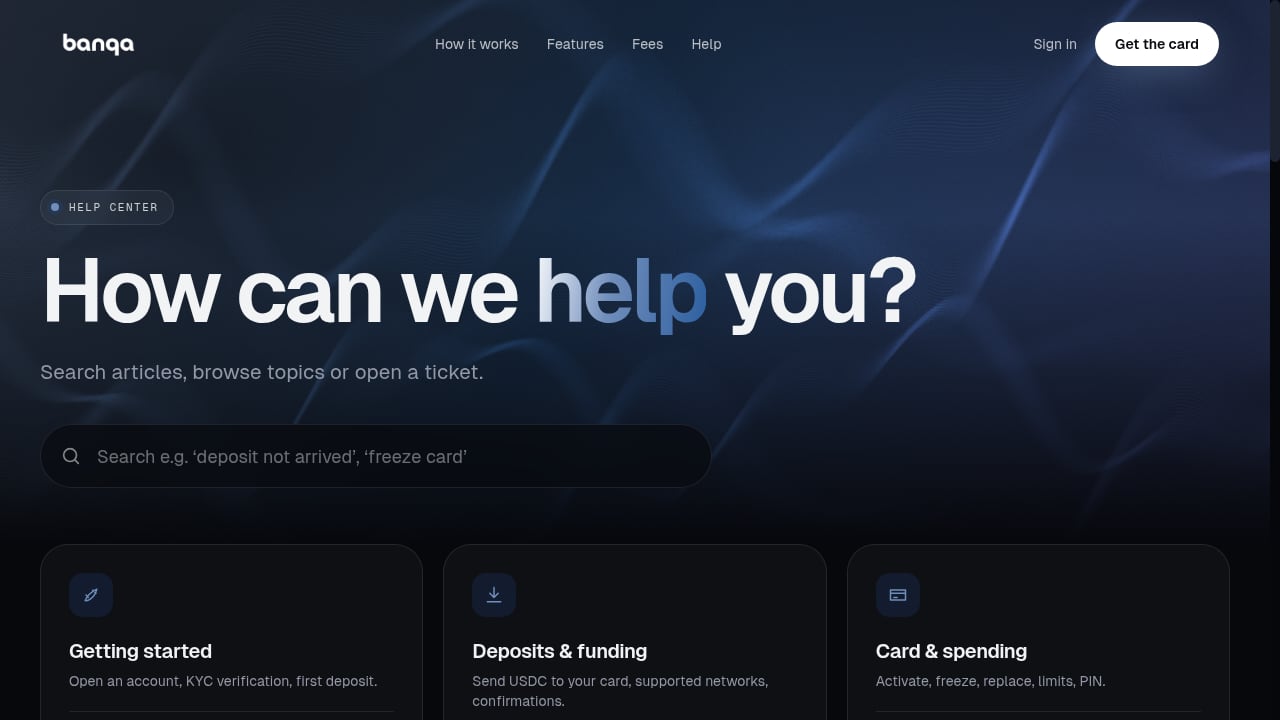
First viewport screenshot of banqa.io.
Banqa sits in a different category from stablecoin payment platforms built for businesses. If your need is merchant payments, invoicing, or fiat settlement, a platform like Request Finance or Reap is a closer fit. Banqa is a spending card, not a payments operations platform.
For teams that want corporate cards with expense management and accounting sync, Sparados is a more direct comparison than Banqa. Banqa's business tier is lighter on expense workflow and heavier on self-custody.
Against consumer crypto cards, Banqa's differentiator is the self-custody model. Cards that custody your funds or require conversion before spending solve a different problem. If you want rewards and broad regional availability, a card like Wirex may be more practical. If you want to keep your keys and spend USDC directly, Banqa is one of the few options that does both.
Decision criteria
Ask yourself these questions before applying:
- Do you already hold USDC? If not, the setup cost and complexity may not be worth it.
- Are you comfortable with self-custody? If losing a recovery phrase would be catastrophic, use a custodial alternative.
- How much do you spend in non-USD currencies? The 1.99% FX fee is the main ongoing cost. High FX volume erodes the value.
- Do you need cash withdrawals? If yes, budget for the ATM fees or use a different card for cash.
- Do you need rewards? Banqa has none. If cashback matters, look elsewhere.
- Can you tolerate eligibility uncertainty? If you need a guaranteed card, apply early and have a backup.
- Is this for a team? If you need expense management and accounting sync, compare business-focused platforms before committing.
FAQ
Is Banqa a bank? No. Banqa is a technology platform, not a bank. It does not provide banking, investment, or deposit-insurance services. The card is issued by a Visa Principal Member under a Visa licence.
What does Banqa cost? No annual fee on the Standard tier. Physical card costs 39.00 USD including delivery. USDC deposits are 0%, USDT deposits 0.25%. FX fee is 1.99% on non-USD transactions. ATM fees are 1.50 USD fixed plus 1% plus 1 USD. Account closure is 10.00 USD.
How do I top up Banqa? Send USDC on Base or Arbitrum to your self-custody wallet from an external wallet or exchange. USDC deposits are fee-free; you pay only network gas. USDT is also supported at 0.25%.
Does Banqa offer cashback? No. Banqa does not advertise cashback or rewards on spending. Its value proposition is self-custody, broad Visa acceptance, and low deposit fees.
Where can I use the Banqa card? Anywhere Visa is accepted, including over 150 million merchant locations worldwide, online and in-store. Apple Pay and Google Pay are supported, and ATM withdrawals are possible with fees.
Is Banqa safe? Your funds are self-custodial, held in a smart-contract wallet you control. Banqa never holds your keys or recovery phrase. The platform reports SOC 2 and penetration testing. However, self-custody means you bear responsibility for your recovery phrase, and crypto assets may be unregulated in your jurisdiction.
Which countries can use Banqa? Banqa does not publish a supported-countries list. Eligibility depends on residence and applicable rules, confirmed during application and KYC. Apply to find out.
Conclusion
Banqa is a well-designed card for a specific user: someone who already holds USDC, values self-custody, and wants to spend stablecoins directly without a manual conversion step. The 0% USDC deposit fee, broad Visa acceptance, and strong card controls are genuine strengths.
The trade-offs are equally real: no cashback, a 1.99% FX fee on non-USD spending, layered ATM costs, unpublished limits, and eligibility uncertainty. If you want a bank card with rewards and predictable cash access, Banqa is not the right tool. If you want to keep your keys and spend your USDC where Visa works, it is one of the more honest options available.
Before applying, confirm your eligibility, check the current fee schedule in the app, and decide whether self-custody fits your risk tolerance. The card gives you control, but control comes with responsibility.
Sources: Banqa official site, Banqa app listing, independent Banqa card review