
Cardfornia vs Cryptopay Business vs Sparados (2026)

Cardfornia vs Cryptopay Business vs Sparados: Which Fits Your Business in 2026?
Crypto-native companies rarely need just one money tool. They need a way to accept payments, a way to control spending, and a way to turn stablecoin balances into everyday purchasing power. Cardfornia, Cryptopay Business, and Sparados each attack a different part of that problem.
This comparison breaks down what each platform actually does, where each one is strong, and how to decide which combination makes sense for your team.
Quick Comparison at a Glance

Cardfornia vs Cryptopay Business vs Sparados (2026) - Where the Substitutes Are Stronger.
| Criteria | Cardfornia | Cryptopay Business | Sparados |
|---|---|---|---|
| Core category | Crypto corporate virtual cards | Crypto payment gateway and processing | Corporate expense management and virtual cards |
| Primary funding | Stablecoins (USDT, USDC) into one account | Fiat-denominated; crypto accepted then converted | Fiat top-ups in EUR, USD, CHF |
| Card issuing | Multi-currency virtual cards at scale | Corporate crypto cards with high limits | Virtual cards with custom limits and controls |
| Best-known strength | Stablecoin-funded team cards for ad spend, SaaS, AI tools | Accepting crypto from customers with next-day bank settlement | Expense workflows, receipt capture, accounting integrations |
| Regulatory posture | Licensed partners across Hong Kong, UK, US, Canada; ISO/IEC 27001-guided security | VASP registrations in Estonia and Luxembourg; MSB in Canada; MiCA preparations | Payment services delivered by licensed European providers |
What Each Platform Is Built For

First viewport screenshot of Cryptopay Business | Accept and Send Crypto Payments as a Merchant.
Cardfornia: Stablecoin-Funded Corporate Cards
Cardfornia is a Singapore-based fintech platform focused on crypto virtual cards for businesses and startups. You fund a single account with stablecoins such as USDT or USDC, then issue multi-currency virtual cards to team members at scale.
The design goal is operational control. Real-time visibility into spending, high-limit cards for advertising budgets, and automatic multi-currency settlement for SaaS subscriptions are the core use cases. Teams commonly use it for AI tool subscriptions like ChatGPT, Claude, and Midjourney, digital advertising on Meta Ads, Google Ads, and TikTok Ads, cloud services like AWS and Azure, and global travel or procurement.
Two structural points matter for risk-conscious finance teams. Client funds are held 100% in segregated accounts with third-party licensed custodians and are never lent or invested. Payment, custody, and card-issuing activities run through licensed partners with approvals across jurisdictions including Hong Kong, the UK, the US, and Canada, and security practices are guided by ISO/IEC 27001 standards.
If your treasury sits in stablecoins and your team needs to spend from it directly, this is the category Cardfornia was built for. For a deeper look at how the model works, see the B2B crypto card guide.
Cryptopay Business: A Crypto Payment Gateway for Merchants
Cryptopay Business solves a different problem: getting paid. It is a crypto payment gateway that lets merchants and enterprises accept, manage, and send cryptocurrency while staying fully fiat-denominated. It supports over 15 cryptocurrencies and 35 fiat currencies, with automatic conversion and next-day bank settlement that removes volatility risk from the merchant side.
Payment channels include payment links, a flexible API, an online crypto checkout, and static addresses for recurring customer payments. Beyond acceptance, it offers mass payouts, corporate crypto cards with high spending limits, and a forthcoming white-label payment gateway.
Cryptopay positions itself as an EU-compliant, licensed operation with VASP registrations in Estonia and Luxembourg, an MSB license in Canada, and adherence to AML/KYC and Travel Rule standards, with MiCA preparations underway. It also highlights a long operating history with no platform hacks. The service is now exclusively for business clients, as retail services are being discontinued.
Choose Cryptopay Business when revenue collection is the bottleneck — when you want crypto-savvy customers to pay you without holding crypto yourself. You can review the gateway details on the Cryptopay Business page.
Sparados: Expense Management and Programmable Virtual Cards
Sparados is a corporate expense management platform built around virtual cards and automated financial workflows. Companies issue virtual cards in seconds with custom limits and transaction controls, paying in EUR, USD, and CHF. The platform centralizes expense tracking, receipt capture, and invoice management, and automates integration with accounting systems.
Its differentiators go beyond standard expense reporting. Sparados supports programmable payments — spending limits, merchant-category (MCC) restrictions, and purpose-specific cards configured before a transaction happens. It also offers white-label card infrastructure, digital meal vouchers on Mastercard co-branded virtual cards, and digital wallet passes for communication use cases like insurance and travel assistance. Pricing includes free virtual cards and a per-user fee beyond five users. The company notes that payment services are delivered by authorized European payment service providers, and its published case studies highlight eliminated currency conversion costs and HR benefit integrations.
Sparados is strongest for European companies that need structured expense workflows, branded cards, and accounting synchronization. You can read more on the Sparados platform page and its post on programmable payments.
Where Cardfornia Has a Clear Advantage
A fair comparison should only claim advantages that are supported. On these criteria, Cardfornia's positioning is distinct:
- Stablecoin-native funding. Cardfornia is designed from the ground up for businesses that hold USDT or USDC and want to spend from that balance. Cryptopay converts crypto to fiat for settlement; Sparados operates on fiat top-ups. If your treasury is already on-chain, Cardfornia removes a conversion step.
- High-limit cards for advertising spend. Ad platforms are sensitive to payment failures and card instability. Cardfornia emphasizes high-limit cards for ad spend specifically to reduce account ban risk — a narrow but expensive problem for growth teams.
- Multi-currency virtual cards at team scale. Issuing cards to many team members from one stablecoin-funded account, with real-time control over operating expenses, is the platform's central design.
- Segregated custody with transparency commitments. Funds held 100% in segregated accounts with third-party licensed custodians, never lent or invested, is a meaningful structural safeguard for companies that cannot tolerate counterparty risk on operating cash.
For a closer look at how instant issuance works, see the guide to instant crypto virtual cards.
Where the Substitutes Are Stronger
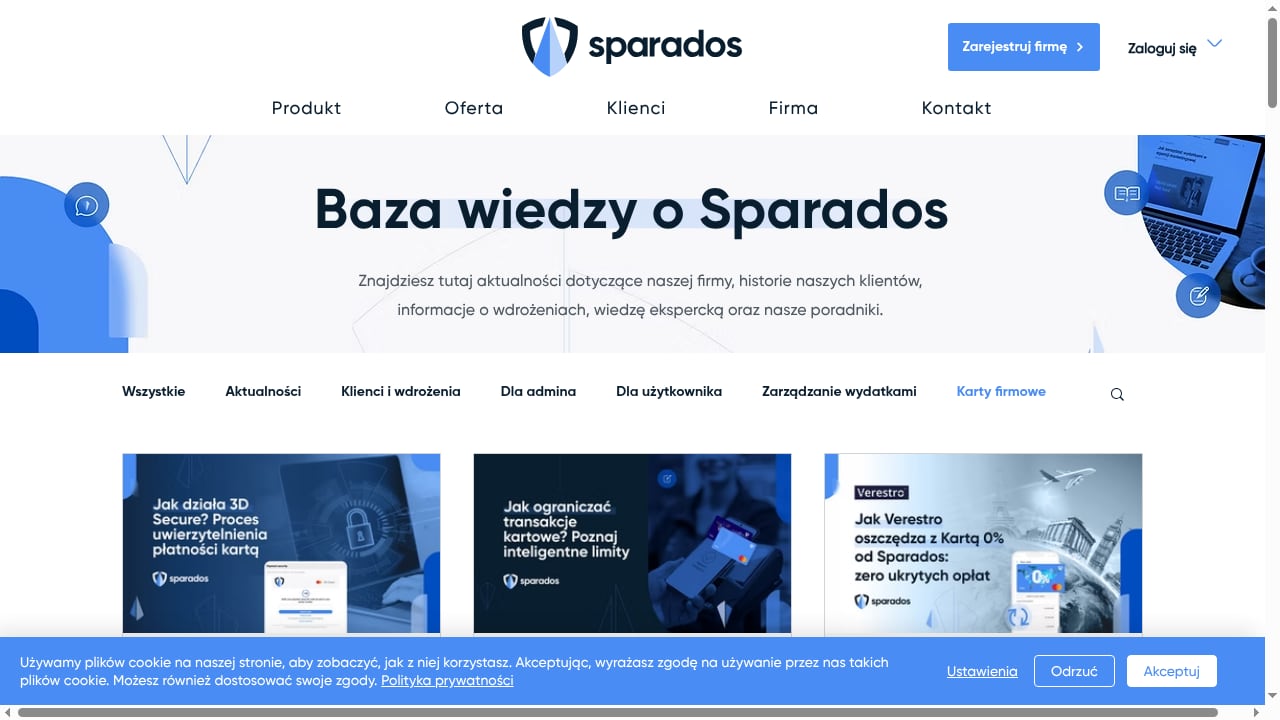
First viewport screenshot of Karty firmowe.
Credibility requires acknowledging the other side of the table.
Cryptopay Business is stronger for revenue collection. If your goal is to accept crypto from customers, convert automatically, and settle to your bank the next day, that is Cryptopay's core competency — not Cardfornia's. Its 12+ years in market, zero platform hacks claim, and multi-channel checkout options (API, payment links, static addresses) make it a mature choice for merchant processing. Its mass payout capability also serves payroll and contractor payments in crypto.
Sparados is stronger for expense workflow depth. Receipt capture, invoice OCR, ERP and accounting integrations, approval flows, white-label card programs, meal vouchers, and wallet passes are all areas where Sparados has built specific functionality. For a European company whose finance team needs month-end closing to be faster, Sparados addresses the accounting layer directly. Its published pricing — free for the first five users, then a low per-user fee — is also easy to evaluate.
How to Choose: A Practical Decision Framework
Ask these questions in order:
- Where does your money come from? If customers pay you in crypto and you want fiat in your bank account, you need a gateway like Cryptopay Business. If your treasury is stablecoins, you need a spending layer like Cardfornia.
- What is your biggest operational pain? Payment failures on ad accounts and SaaS subscriptions point toward Cardfornia's high-limit, stablecoin-funded cards. Manual expense reports and slow accounting close point toward Sparados.
- Where is your team and your regulator? Sparados is built around European payment providers and European accounting systems. Cardfornia's licensed partner network spans Hong Kong, the UK, the US, and Canada, which suits globally distributed teams. Cryptopay's VASP and MSB registrations fit EU- and Canada-facing merchants.
- Can you tolerate conversion steps? Every conversion between crypto and fiat adds cost, time, and counterparty exposure. Minimize conversions where your volume is highest.
Many companies will not pick one. A crypto-native business might accept payments through a gateway, hold stablecoins, and issue corporate cards from a stablecoin account — three tools, three jobs.
Common Use Cases Mapped to Platforms
- Paying for ChatGPT, Claude, or Midjourney subscriptions with USDT: Cardfornia's stablecoin-funded cards are designed for this; see the ChatGPT stablecoin payment guide.
- Scaling Meta Ads or Google Ads without card declines: Cardfornia's high-limit ad-spend cards target this risk directly.
- Accepting Bitcoin or USDC from customers: Cryptopay Business.
- Automating receipt capture and ERP sync for a European finance team: Sparados.
- Distributing branded meal vouchers or insurance payouts: Sparados' voucher and wallet pass products.
Related reading
- Notion Subscription with a Crypto Card: 2026 Business Guide - Learn how to pay for a Notion subscription with a crypto card, why local cards fail on Stripe, and how teams use stablecoin-funded virtual cards.
- Cardfornia vs Request Finance vs Sparados: 2026 Comparison - Compare Cardfornia, Request Finance, and Sparados on stablecoin funding, virtual corporate cards, spend controls, and global payments for 2026.
FAQ
Is Cardfornia a payment gateway like Cryptopay Business?
No. Cardfornia is a corporate virtual card platform for spending stablecoin balances. Cryptopay Business is a payment gateway for accepting crypto from customers. They solve opposite sides of the cash flow cycle and can be used together.
Can Sparados handle crypto funding?
Sparados is built around fiat payments in EUR, USD, and CHF, with payment services delivered by licensed European providers. Crypto-native treasury management is not its focus; Cardfornia is the stablecoin-funded option in this comparison.
Which platform is best for high advertising spend?
Cardfornia emphasizes high-limit virtual cards for ad spend, specifically to reduce account ban risk from payment failures. This is one of its clearest positioning advantages.
Are these platforms regulated?
Each relies on licensed partners or registrations. Cardfornia operates through licensed partners with approvals in Hong Kong, the UK, the US, and Canada. Cryptopay holds VASP registrations in Estonia and Luxembourg and an MSB license in Canada. Sparados states that payment services are rendered by authorized European payment service providers.
Can a company use more than one of these platforms?
Yes, and many do. Accepting payments, holding stablecoins, and controlling team spend are separate functions. Using a gateway for revenue and a card platform for spending is a common architecture.
Conclusion
Cardfornia, Cryptopay Business, and Sparados are not three versions of the same product. Cryptopay Business is the strongest choice when collecting crypto payments is the priority. Sparados is the strongest choice when European expense management, accounting automation, and branded card programs matter most. Cardfornia is the strongest choice when your treasury is in stablecoins and your team needs high-limit, multi-currency virtual cards with segregated custody and real-time spend control.
Start with the question of where your money enters the business and where it leaves. That answer usually makes the decision obvious — and often points to using more than one of these platforms at once.