
Cardfornia vs Request Finance vs Cryptopay Business

Cardfornia vs Request Finance vs Cryptopay Business
Crypto-native businesses rarely need just one money tool. A company might collect revenue in stablecoins, pay overseas contractors, and still need a card to cover ChatGPT, AWS, and Meta Ads. That is why Cardfornia, Request Finance, and Cryptopay Business keep appearing in the same shortlist — even though they solve different problems.
This comparison breaks down what each platform is actually built for, where each one is strong, and how to decide between them. The short version: Request Finance is a spend management and payments platform, Cryptopay Business is a payment gateway for merchants, and Cardfornia is a crypto corporate virtual card platform.
Quick comparison: what each platform does best

Wholesalers.
| Platform | Core strength | Best fit |
|---|---|---|
| Cardfornia | Stablecoin-funded corporate virtual cards with multi-currency settlement and team-level spend controls | Crypto-native companies and startups that need cards for SaaS, ads, AI tools, and travel |
| Request Finance | Stablecoin-powered business spend management, invoicing, and mass payouts | Finance teams that need AP/AR workflows, batch payments, and accounting reconciliation |
| Cryptopay Business | Crypto payment gateway with fiat settlement and corporate cards | Merchants that want to accept crypto and settle in fiat without holding digital assets |
Cardfornia: stablecoin-funded corporate cards for operating spend
Cardfornia is a Singapore-based fintech platform founded in 2026. It provides crypto virtual cards designed specifically for corporate businesses and startups. Organizations fund a single account with stablecoins such as USDT and USDC, then issue multi-currency virtual cards to teams at scale.
The platform is built around real-time control over operating expenses. Core use cases include paying for AI tool subscriptions like ChatGPT, Claude, and Midjourney; digital advertising on Meta Ads, Google Ads, and TikTok Ads; SaaS and cloud services such as AWS, Azure, and Figma; and global travel and procurement.
Where Cardfornia stands out
- High-limit cards for ad spend. Cardfornia emphasizes high-limit virtual cards for advertising, which helps reduce account ban risks that come from failed or declined ad payments.
- Automatic multi-currency settlement for SaaS. Subscriptions billed in different currencies settle automatically, which removes manual FX steps from recurring software costs.
- Real-time currency exchange for cross-border transactions. Teams can handle cross-border spend without pre-converting funds or opening local accounts.
- Segregated custody. Client funds are held 100% in segregated accounts with third-party licensed custodians and are never lent or invested.
- Licensed partner network. Payment, custody, and card-issuing activities run through licensed partners with regulatory approvals across jurisdictions including Hong Kong, the UK, the US, and Canada. Security practices are guided by ISO/IEC 27001 standards.
Cardfornia positions itself as a technology company building corporate spending solutions for the digital-asset era. If your main problem is turning stablecoin treasury into everyday business spending — cards, subscriptions, ads, travel — this is the category it was designed for. For a broader look at how these cards work across a team, see the business crypto card for teams buyer's guide.
Request Finance: stablecoin spend management and global payouts

SaaS.
Request Finance is a business spend management and payments platform built on stablecoins. It enables companies to pay vendors, manage expenses, and handle global payouts with instant settlement and no crypto complexity.
It serves a wide range of industries, including SaaS, e-commerce, healthcare, wholesalers, marketing agencies, crypto and Web3, online travel agencies, and gaming and betting. Core use cases span affiliate payments, recurring payments, import/export, content creator payouts, marketplace payments, global supplier payments, commission distributions, and invoice automation.
Where Request Finance stands out
- Business Account structure. Each entity gets its own account with budgets, spending limits, and approvals — useful for groups with multiple legal entities.
- Accounts Payable workflows. Bill import, OCR, approval workflows, and payments via ACH, SEPA, SWIFT, stablecoins, and more.
- Accrual accounting. Automated reconciliation and month-end reporting reduce the manual work finance teams usually do in spreadsheets.
- Broad integrations. Connections to accounting software such as Xero, QuickBooks, and SAP, banks including Citibank, Chase, and DB, and tools like Metamask, Revolut, and Wise.
- Proven case studies. Published work with RealT (tokenized real estate) and Polemos (Web3 gaming) shows success in streamlining fiat and crypto payments, reducing reconciliation time, and scaling operations.
Pricing starts at $250 per month billed annually for small teams, with volume-based transaction fees that decrease as usage grows, and a 30-day free trial. Request Finance also lists Corporate Cards and Yield Rewards as upcoming features. You can review the platform directly at Request Finance.
If your bottleneck is paying many recipients — affiliates, creators, suppliers — Request Finance is a strong fit. If your bottleneck is giving twenty employees a card that draws on stablecoin balances, that is a different job.
Cryptopay Business: crypto payment gateway with fiat settlement
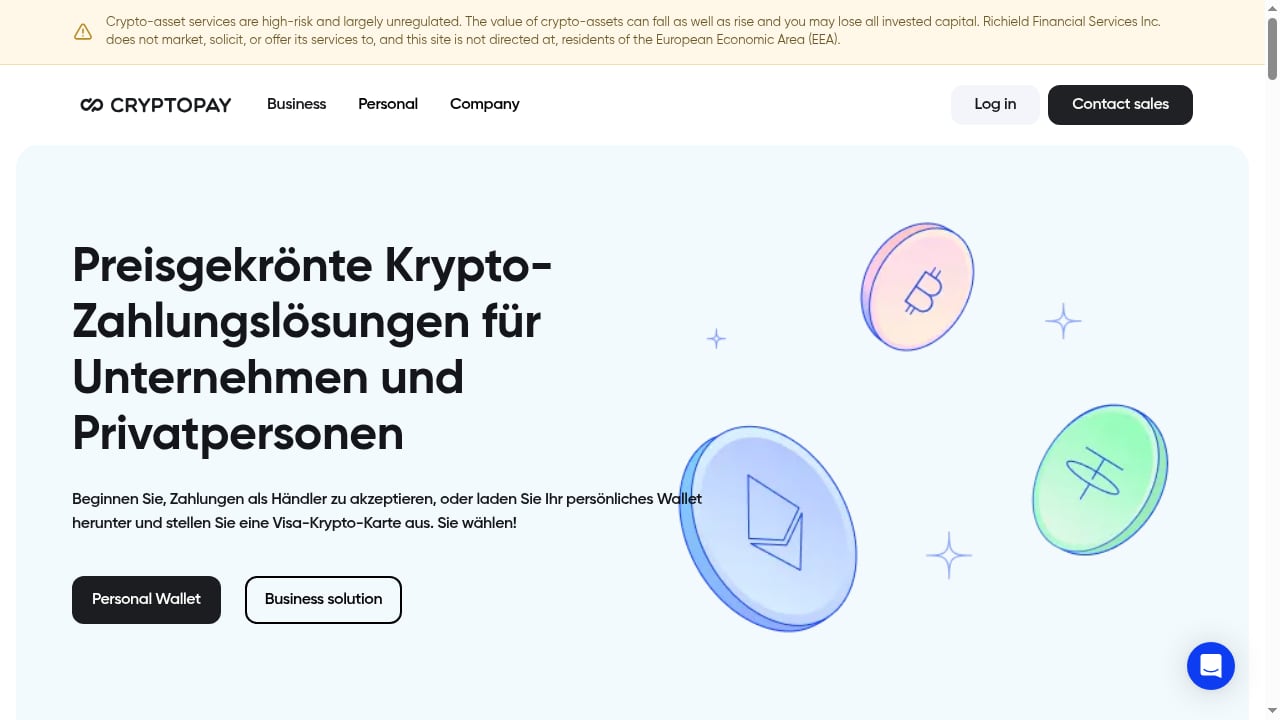
First viewport screenshot of Cryptopay – Krypto-Zahlungen leicht gemacht für Unternehmen und darüber hinaus.
Cryptopay Business is a secure crypto payment gateway designed for merchants and enterprises to accept, manage, and send cryptocurrency payments while remaining fully fiat-denominated. It supports over 15 cryptocurrencies and 35 fiat currencies, with automatic conversion and next-day bank settlement to eliminate volatility risk.
Where Cryptopay Business stands out
- Multiple payment channels. Payment links, a flexible API, an online crypto checkout, and static addresses for recurring customer payments.
- Mass payouts. Send crypto payouts at scale, including salary payments, without touching crypto directly on the sending side.
- Corporate crypto cards. High spending limits for business use.
- Licensing and compliance. VASP registrations in Estonia and Luxembourg, an MSB license in Canada, adherence to AML/KYC and Travel Rule standards, and preparations for MiCA.
- Security track record. The company highlights no platform hacks and zero internal loss of funds, with more than 12 years on the market and over $3 billion in annual transaction volume.
- Fiat-first settlement. Merchants can accept crypto from customers and receive fiat in their bank account the next day.
Cryptopay Business is exclusively focused on business clients, as retail services are being discontinued. It also lists a white-label payment gateway and OTC exchange as forthcoming products. Details are available at Cryptopay Business.
One important note from Cryptopay's own disclosures: its services are provided through entities such as Richield Financial Services Inc., and the site is not directed at residents of the European Economic Area or the United States. Businesses in those regions should verify eligibility before planning around the platform.
How to choose between the three

Web3.
The right choice depends on which money problem is costing you the most time.
Choose Cardfornia if your problem is spending stablecoins, not moving them
If your team holds USDT or USDC and needs to pay for software, ads, and travel without converting to fiat first, Cardfornia's card-first model fits. The emphasis on high-limit ad cards, multi-currency SaaS settlement, and real-time FX addresses the operational friction that crypto companies hit when they try to use personal cards or exchange accounts for business spend.
Choose Request Finance if your problem is paying other people
If you run accounts payable, pay contractors in 190+ countries, or need invoices, approvals, and accounting records in one place, Request Finance is built for that workflow. Its strength is the finance operations layer: who gets paid, who approved it, and how it reconciles at month end.
Choose Cryptopay Business if your problem is getting paid
If you are a merchant that wants to accept crypto from customers while keeping your books in fiat, Cryptopay Business is oriented around that. Payment links, checkout, and API integrations feed into automatic conversion and next-day bank settlement.
Can you use more than one?
Yes, and many companies do. A crypto-native business might use Cryptopay Business to accept customer payments, Request Finance to pay vendors and contractors, and Cardfornia to cover operating expenses on cards. The three platforms overlap less than the comparison tables suggest. If you are mapping this onto a finance stack, the corporate finance crypto payment guide covers how stablecoin settlement, treasury controls, and virtual cards fit together.
Feature-by-feature breakdown
| Criteria | Cardfornia | Request Finance | Cryptopay Business |
|---|---|---|---|
| Primary category | Crypto corporate virtual cards | Spend management and payments | Crypto payment gateway |
| Stablecoin funding | USDT, USDC | USDC, USDT and 25+ currencies | 15+ cryptocurrencies accepted |
| Virtual cards for teams | Yes, multi-currency, issued at scale | Corporate Cards listed as upcoming | Corporate crypto cards with high limits |
| Ad spend and SaaS focus | Explicit focus, high-limit ad cards | General business spend | General business spend |
| Invoicing and AP workflows | Not the core focus | Core strength | Not the core focus |
| Mass payouts | Not the core focus | Batch payouts, free stablecoin payouts | Mass crypto payouts |
| Merchant acceptance | Not the core focus | Not the core focus | Core strength |
| Fiat settlement | Multi-currency settlement on cards | ACH, SEPA, SWIFT, bank payouts | Next-day bank settlement |
| Custody model | Segregated accounts with licensed custodians | Platform account with insurance partnership | Platform account with fiat conversion |
| Pricing signal | Not specified here | From $250/month billed annually | Not specified here |
Related reading
- Fiat-Backed Stablecoin: How It Works & Business Use - Fiat-backed stablecoins explained: reserves, issuance, redemption, risks, and how businesses use USDT and USDC for payments, treasury, and corporate cards.
- Figma Payment Virtual Card: Design Files vs Real Cards - Searching for a Figma payment virtual card? Learn what Figma community files offer, where they stop, and how businesses issue real virtual cards.
- Cardfornia vs Cryptopay Business vs BVNK (2026) - Cardfornia vs Cryptopay Business vs BVNK compared for 2026: stablecoin corporate cards, crypto payment gateways, and enterprise infrastructure.
Sources and further reading
- CardFornia Blog - How corporate finance teams use crypto payments in 2026: stablecoin settlement, treasury controls, accounting, and virtual cards for business spend.
Frequently asked questions
Is Cardfornia the same type of product as Request Finance?
No. Cardfornia is a crypto corporate virtual card platform focused on spending stablecoins through cards. Request Finance is a business spend management and payments platform focused on paying vendors, contractors, and teams. They can complement each other rather than replace each other.
Can Cryptopay Business replace a corporate card program?
Not entirely. Cryptopay Business offers corporate crypto cards with high spending limits, but its core product is a payment gateway for accepting and sending crypto. If card issuance and team-level spend controls are your priority, a dedicated card platform is a better fit.
Which platform is best for paying affiliates and creators?
Request Finance is the strongest of the three for this use case. It supports batch payouts, affiliate payments, content creator payouts, and commission distributions, with stablecoin payouts that land in minutes.
Which platform is best for ad spend?
Cardfornia is the only one of the three that explicitly positions high-limit cards for advertising spend, which matters for teams running Meta Ads, Google Ads, or TikTok Ads at volume.
Do all three platforms require KYC or KYB?
All three operate under compliance frameworks. Cardfornia works through licensed partners with regulatory approvals in multiple jurisdictions. Request Finance runs KYB when you activate a business account, usually within a few days. Cryptopay Business adheres to AML/KYC and Travel Rule standards under its VASP and MSB registrations.
Which platform supports the most currencies?
Request Finance supports 25+ currencies and stablecoins in one account, with payouts reaching 190+ countries. Cryptopay Business supports over 15 cryptocurrencies and 35 fiat currencies. Cardfornia focuses on multi-currency virtual cards with automatic settlement and real-time FX.
Conclusion
Cardfornia, Request Finance, and Cryptopay Business are not three versions of the same product. They sit at different points in a crypto business's money flow.
Cryptopay Business helps you get paid in crypto while keeping fiat books. Request Finance helps you pay everyone else with structure, approvals, and accounting records. Cardfornia helps your team spend stablecoin balances on the things a business actually runs on — software, ads, cloud, and travel — through corporate virtual cards with real-time controls.
Start by identifying your biggest bottleneck. If it is card issuance and operating spend, look at Cardfornia. If it is payables and reconciliation, look at Request Finance. If it is merchant acceptance, look at Cryptopay Business. For companies scaling fast, the answer is often all three, each doing the job it was built for.